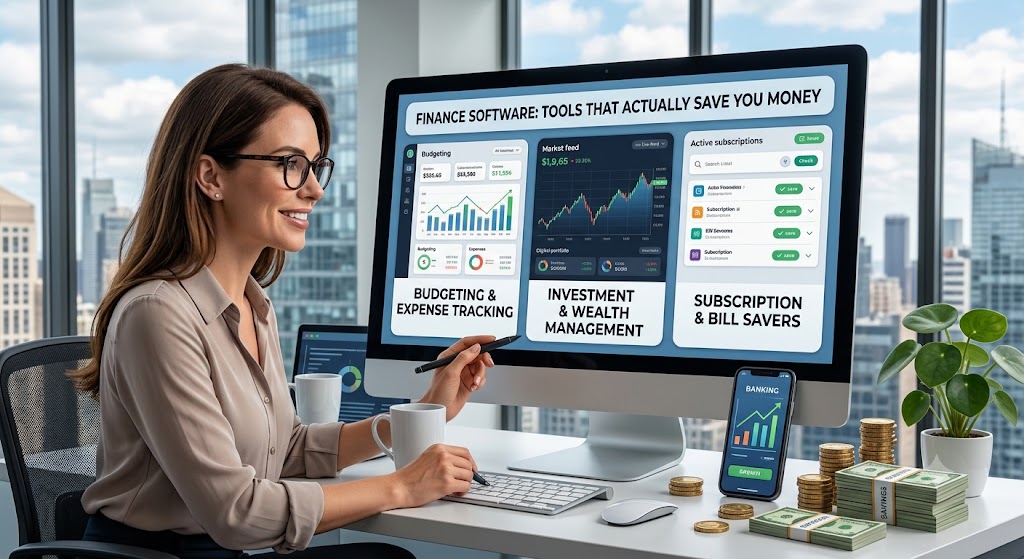
Finance Software That Earns Its Place on Your Screen
The best financial software does not simply show numbers. It helps you notice waste, organize decisions, avoid unnecessary fees, and understand where your money is actually going.
Finance software has changed considerably. What once required spreadsheets, calculators, folders of receipts, and hours of manual record keeping can now be handled through connected applications and automated dashboards. But there is an important distinction between software that looks impressive and software that genuinely improves your finances.
A colorful dashboard does not automatically save money. An application with hundreds of features can still be useless if you never open it. The tools that deserve a place in your financial routine are the ones that help you make better decisions with less effort.
For households, freelancers, and small businesses, that usually means focusing on a few practical jobs: tracking spending, managing bills, monitoring cash flow, organizing records, preparing for taxes, and identifying unnecessary expenses.
1. Budgeting Software: The First Place to Start
Budgeting tools are among the simplest financial applications, but they can be surprisingly powerful when used consistently. Their primary purpose is to turn spending into something visible.
Without tracking, small purchases can disappear into the background. A few subscriptions, frequent food deliveries, unused memberships, and impulse purchases may individually seem harmless. Together, they can create a meaningful monthly expense.
A budgeting application can categorize transactions and give you a clearer picture of where your money is going. More importantly, it can help you compare actual spending with the amount you intended to spend.
The goal should not be creating a perfect budget that becomes impossible to maintain. A useful system should be simple enough to keep using month after month.
Know where money is going.
Find unnecessary spending.
Change the plan before problems grow.
2. Subscription Trackers Can Find Quiet Money Leaks
Subscriptions are one of the easiest expenses to forget because they often leave the bank account automatically.
A subscription-management tool or a well-organized budgeting application can help identify recurring charges. This can be especially useful when several services are billed at different times of the month.
Once recurring expenses are visible, ask a straightforward question: Would I sign up for this service again today?
If the answer is no, cancellation can create an immediate saving without changing your lifestyle very much.
This is one of the clearest examples of financial software doing something valuable. It does not magically reduce the price of a service. It simply helps you notice that you are still paying for something you no longer need.
3. Bill Management Tools Help Prevent Expensive Mistakes
Late payments can create unnecessary fees, missed opportunities, and avoidable stress. Bill-management software can provide reminders and organize recurring obligations in one place.
This is particularly useful when someone manages rent, utilities, insurance, credit cards, memberships, loans, and other regular payments.
Automation can help, but it should be used thoughtfully. Automatic payments are convenient, yet account balances and transaction details should still be reviewed. An incorrect charge or unexpected price increase can otherwise continue unnoticed.
Three Questions Worth Asking
1. What recurring payments changed?
2. Which services am I no longer using?
3. Did any unexpected fees appear?
4. Expense Tracking Is Especially Valuable for Freelancers
For freelancers and small-business owners, finance software becomes more than a personal budgeting tool. It can help separate business income from expenses and organize records that may be needed later.
Instead of searching through months of bank statements at tax time, properly categorized expenses can be easier to review throughout the year.
Common categories may include software, advertising, equipment, professional services, travel, office expenses, and other legitimate business costs depending on the business and applicable tax rules.
Good record keeping can save time, but software should not replace professional tax advice when financial decisions become complicated.
5. Accounting Software Can Save More Time Than Money
Not every financial benefit appears directly as a lower expense. Time is valuable too.
Accounting software can reduce repetitive work such as recording transactions, creating invoices, organizing expenses, and preparing financial reports. For a growing business, that time saving can become significant.
The best system depends on the size and complexity of the operation. A freelancer with a handful of monthly transactions may need something very different from a company with employees, inventory, multiple revenue streams, and complex reporting requirements.
The mistake is choosing the most powerful platform simply because it has the largest feature list.
6. Cash-Flow Software Helps Businesses See Problems Earlier
Profit and cash are not exactly the same thing.
A business can appear profitable on paper while still experiencing difficulty paying bills because money is arriving later than expected. Cash-flow tools help businesses understand when money is expected to come in and when payments are due.
This can help owners prepare for slow periods, avoid unnecessary borrowing, and make purchasing decisions with more confidence.
7. Investment Tracking Software Has a Different Job
Investment applications can show portfolio values, asset allocation, performance, dividends, and other information. Their main benefit is visibility rather than automatically producing better investment returns.
A useful dashboard can make it easier to understand whether a portfolio has become heavily concentrated in one asset, whether investments match a planned allocation, and how the overall portfolio has changed over time.
However, investors should be careful about turning every movement on a dashboard into a reason to trade. More information does not automatically mean better decisions.
Financial software should support a strategy, not replace one.
8. Price Comparison and Shopping Tools Can Reduce Everyday Costs
Some of the most useful financial tools are not traditional finance applications at all.
Price comparison tools, shopping alerts, coupon systems, and product-price trackers can help consumers avoid paying more than necessary for common purchases.
The important distinction is between saving money and encouraging additional shopping. A discount is not a saving if it convinces you to purchase something you never needed.
A Better Shopping Rule
Need first → Compare second → Discount third → Buy last.
9. AI Is Making Finance Software More Useful
Artificial intelligence is increasingly being added to financial applications. It can help summarize transactions, identify unusual spending patterns, answer questions about financial records, categorize information, and generate reports.
For businesses, AI can also help explain financial information in simpler language. Instead of manually searching through multiple reports, an owner may be able to ask questions such as which expense categories increased or which invoices remain outstanding.
However, financial information is sensitive. Users should understand what data a service collects, how it is stored, and what permissions the application receives before connecting important accounts.
10. Security Should Matter as Much as Features
Finance software often handles highly sensitive information. That means convenience should never be the only deciding factor.
Before connecting a bank account, payment card, investment account, or business system, investigate the provider’s security practices and privacy policies. Use strong, unique credentials and multi-factor authentication whenever available.
Be especially cautious with applications that request more access than they logically need.
A financial application that saves you $50 while exposing sensitive information is not a good bargain.
The Tools That Actually Save You Money Have One Thing in Common
They make financial information easier to act on.
A budgeting application shows that restaurant spending has increased. A subscription tracker reveals an unused service. An accounting platform organizes expenses. A cash-flow dashboard shows a future shortfall. A price tracker shows that waiting could lead to a better purchase price.
The software itself does not make the financial decision. It gives you better information so that you can make it.
Worth Paying For
Software that saves meaningful time, prevents costly mistakes, improves organization, or consistently helps identify unnecessary spending.
Probably Not Worth It
Tools you rarely use, duplicate features you already have, or subscriptions that cost more than the value they provide.
Build a Finance Stack You Will Actually Use
You do not need ten financial applications.
For many people, a simple setup can cover most needs: one budgeting or money-management system, a secure password manager, a reliable method for storing financial records, and appropriate tools for investing or business accounting if those areas apply.
Businesses may need additional systems for invoices, payroll, expenses, taxes, inventory, or cash flow. But each addition should have a clear purpose.
The strongest financial setup is usually not the most complicated one. It is the one you can understand and maintain.
Visibility → Organization → Action → Review
First see where the money goes. Then organize it. Make a decision based on the information. Finally, review whether the decision actually improved the result.
Final Takeaway
Finance software is most valuable when it changes behavior. A dashboard alone will not improve your finances, and another subscription will not magically create savings.
The right tools can, however, make hidden expenses easier to find, recurring bills easier to manage, business records easier to organize, cash flow easier to understand, and financial decisions easier to evaluate.
That is the real standard worth using in 2026: choose software because it solves a financial problem, not because it has the most impressive feature list.
Start small, protect your financial data, remove tools that provide little value, and keep the applications that genuinely save time or money. When software makes good financial habits easier, its subscription can become one of the more worthwhile expenses in your budget.