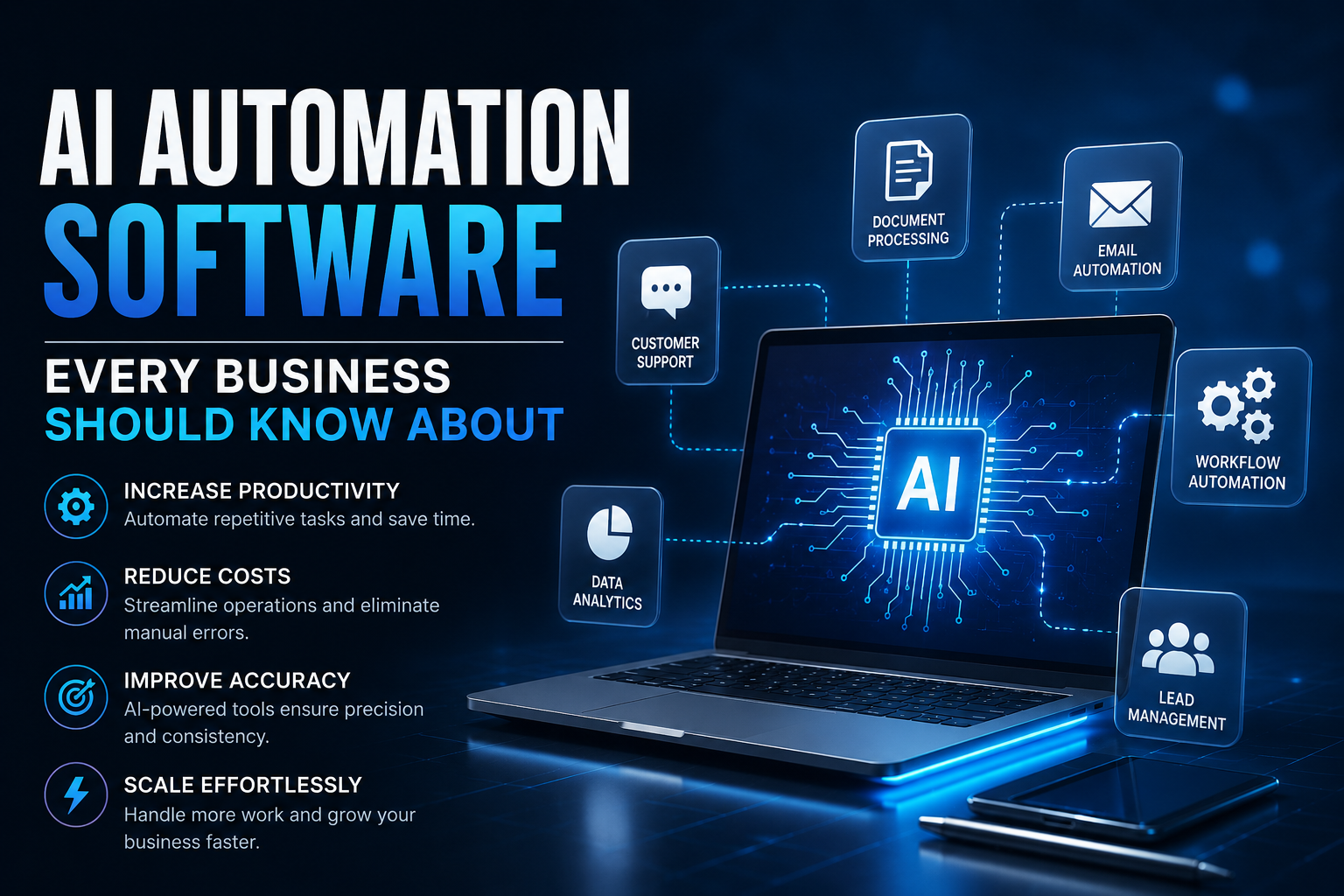
Running a business often means managing dozens of repetitive tasks every day. Customer inquiries need responses, leads must be organized, invoices have to be tracked, reports require updates, emails need follow-ups, and team workflows must stay coordinated. While each task may only take a few minutes, together they consume countless hours every week. This is where AI automation software has become one of the most valuable business technologies in 2026. Instead of spending time on repetitive administrative work, businesses can automate routine processes and allow teams to focus on strategy, growth, customer relationships, and revenue-generating activities.
AI automation software combines artificial intelligence with workflow automation to reduce manual effort, improve consistency, and increase operational efficiency. These tools can perform tasks automatically, analyze information, trigger actions, generate content, organize data, and even assist with decision-making. Businesses of every size are adopting automation platforms because they save time, reduce errors, and help teams accomplish more without increasing workload.
◈ Why Automation Matters More Than Ever
Modern businesses operate across multiple platforms including email, CRM systems, marketing software, accounting tools, project management platforms, ecommerce stores, and customer support channels. Managing these systems manually creates inefficiencies. AI automation helps connect processes and eliminates repetitive work that slows productivity.
What Makes AI Automation Different?
Traditional automation follows predefined rules. AI automation goes further by analyzing information, understanding context, generating responses, identifying patterns, and adapting workflows based on data. This allows businesses to automate more complex processes that previously required human involvement.
For example, instead of simply forwarding customer emails, AI can categorize inquiries, draft responses, prioritize urgent requests, and route conversations to the appropriate department automatically.
| Traditional Automation | AI Automation |
|---|---|
| Follows fixed rules | Learns from context |
| Simple repetitive actions | Complex decision support |
| Limited flexibility | Adaptive workflows |
| Manual supervision | Greater autonomy |
1. Zapier AI
Zapier remains one of the most widely used automation platforms for businesses. It connects thousands of applications and allows workflows to run automatically between systems. AI enhancements make workflows even more powerful by helping process information, generate content, summarize data, and automate decision-based actions.
Businesses use Zapier to automate lead management, customer onboarding, internal notifications, marketing campaigns, form submissions, and sales processes.
Best Use Cases: Workflow automation, lead routing, CRM updates, email automation, and app integration.
2. Make (Formerly Integromat)
Make is a powerful visual automation platform that allows businesses to create highly customized workflows. Its flexible interface enables organizations to connect apps, process data, automate approvals, and manage complex business operations with minimal manual involvement.
Many businesses choose Make when they require advanced automation beyond simple trigger-based workflows.
Best Use Cases: Advanced process automation, data synchronization, business workflows, and system integrations.
3. HubSpot AI Automation
HubSpot combines CRM functionality with AI-powered marketing, sales, and customer service automation. Businesses can automate lead nurturing, email campaigns, customer communication, pipeline management, and marketing workflows.
AI features help generate content, improve engagement strategies, and support personalized customer experiences at scale.
Best Use Cases: Sales automation, marketing workflows, customer relationship management, and lead nurturing.
4. Microsoft Copilot
Microsoft Copilot integrates directly with business applications such as Word, Excel, Outlook, Teams, and PowerPoint. It automates document creation, meeting summaries, spreadsheet analysis, email drafting, and data interpretation.
Organizations already using Microsoft software often gain significant productivity improvements through Copilot’s built-in AI capabilities.
Best Use Cases: Office productivity, reporting, document automation, and meeting management.
5. Notion AI
Notion AI helps automate documentation, project planning, knowledge management, meeting summaries, task creation, and content organization. It allows teams to centralize information while reducing the effort required to maintain documentation.
For businesses that manage large amounts of information, Notion AI can significantly improve organization and collaboration.
Best Use Cases: Internal documentation, project coordination, team knowledge bases, and planning.
6. Intercom AI
Customer support teams often spend considerable time answering repetitive questions. Intercom AI automates customer conversations, provides instant responses, routes requests, and assists support agents with suggested answers.
Businesses can improve response times while maintaining high-quality customer experiences.
Best Use Cases: Customer support automation, live chat assistance, and customer engagement.
7. ClickUp AI
ClickUp combines project management with AI-powered productivity features. Teams can automate task creation, project updates, summaries, planning activities, and workflow management from a single platform.
This helps reduce administrative overhead while improving project visibility and accountability.
Best Use Cases: Project management, task automation, team coordination, and productivity improvement.
8. Salesforce Einstein AI
Salesforce Einstein adds artificial intelligence to customer relationship management processes. It helps businesses predict sales opportunities, automate customer interactions, score leads, and generate insights from customer data.
For organizations focused on sales growth and customer engagement, Einstein can improve efficiency throughout the sales cycle.
Best Use Cases: Sales forecasting, lead scoring, customer intelligence, and CRM automation.
Key Benefits of AI Automation Software
Businesses adopt automation software for many reasons, but the most significant advantage is the ability to reduce repetitive work while improving operational consistency.
- Reduces manual workload.
- Improves productivity.
- Minimizes human errors.
- Accelerates business processes.
- Supports scalability.
- Enhances customer experiences.
- Improves team efficiency.
- Provides better operational visibility.
◈ Successful Automation Pattern
- Identify repetitive tasks.
- Measure time spent manually.
- Select appropriate automation software.
- Start with simple workflows.
- Monitor performance carefully.
- Expand automation gradually.
- Review results regularly.
- Optimize workflows continuously.
Mistakes Businesses Should Avoid
While automation can provide substantial benefits, implementation should be approached thoughtfully. Businesses that automate without planning often encounter inefficiencies and unnecessary complexity.
- Automating broken processes.
- Using too many platforms simultaneously.
- Ignoring employee training.
- Failing to monitor automated workflows.
- Overlooking data security considerations.
- Expecting automation to solve every business problem.
The most successful automation strategies focus on solving specific operational challenges rather than adopting technology for its own sake.
Final Thoughts
AI automation software has become a powerful tool for businesses seeking greater efficiency, productivity, and scalability. By automating repetitive processes, improving workflow management, and supporting smarter decision-making, these platforms allow organizations to focus more time on growth and innovation.
Solutions such as Zapier AI, Make, HubSpot AI, Microsoft Copilot, Notion AI, Intercom AI, ClickUp AI, and Salesforce Einstein each offer unique strengths that address different operational needs. The most effective approach is to identify business bottlenecks and implement automation where it creates measurable value.
Businesses that embrace AI automation strategically can streamline operations, reduce costs, improve customer experiences, and build stronger foundations for long-term success in an increasingly competitive digital environment.