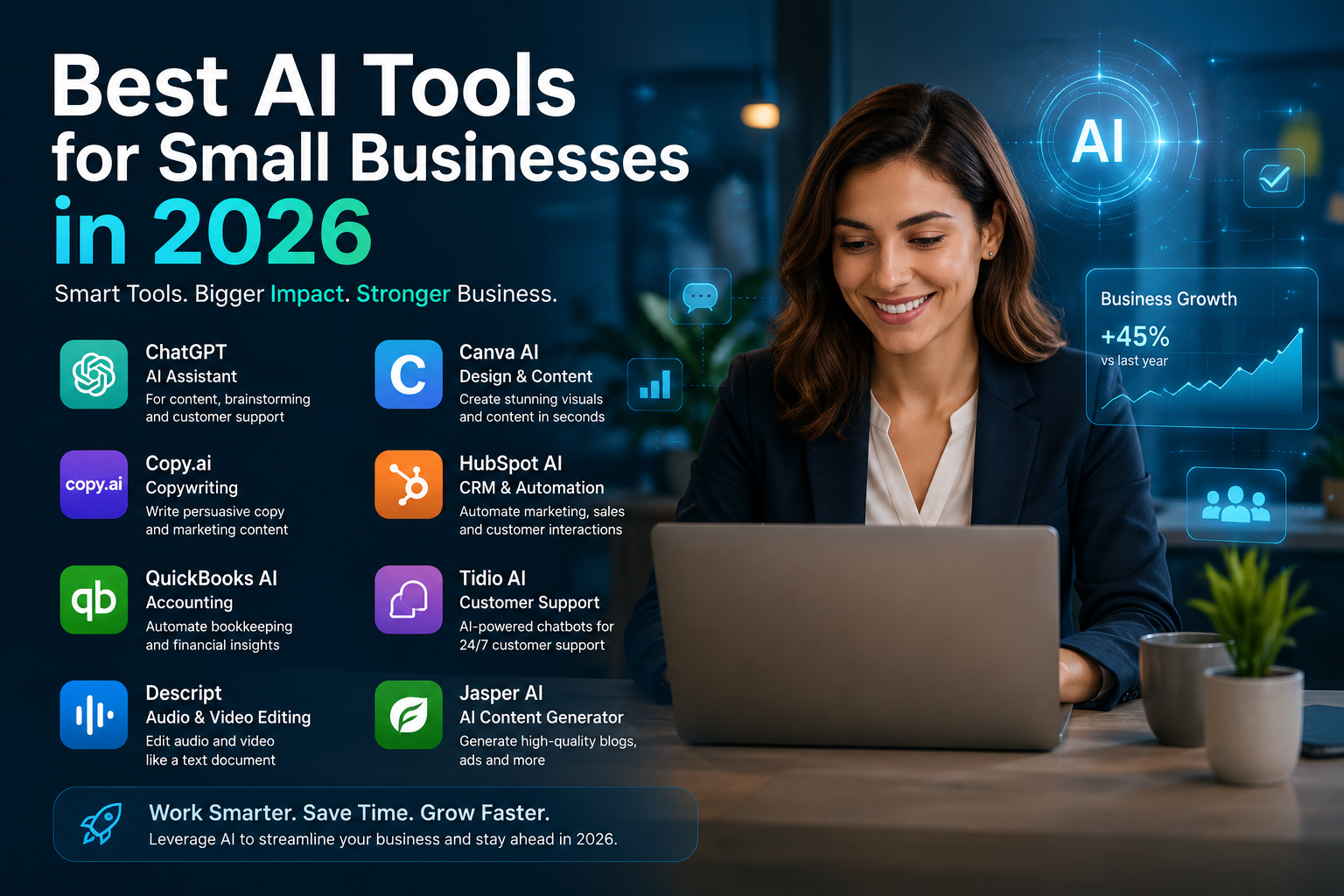
Artificial intelligence has quickly become one of the most valuable technologies for small businesses. In 2026, AI tools are no longer limited to large companies with big budgets. Small businesses can now use AI to write content, automate customer support, manage marketing campaigns, analyze data, improve productivity, and reduce repetitive manual work. The right AI tools can help small teams operate more efficiently, make better decisions, and compete with larger businesses.
For many small business owners, the biggest challenge is not whether AI is useful, but which tools are actually worth using. The market is filled with AI software for writing, design, automation, sales, customer service, accounting, scheduling, and analytics. Choosing the right tools depends on business goals, budget, team size, and daily workflow.
◆ Why AI Tools Matter for Small Businesses
AI tools help small businesses save time, reduce workload, improve customer experience, and complete tasks faster. Instead of hiring large teams for every function, businesses can use AI-powered software to support marketing, operations, sales, and administration.
What Small Businesses Can Use AI For
AI can support many areas of business operations. A small company may use AI to write product descriptions, respond to customer questions, create social media posts, summarize documents, analyze sales data, or automate email workflows.
The best results usually come when AI is used to assist human work rather than fully replace it. Business owners should use AI to speed up tasks, improve consistency, and reduce repetitive work while still reviewing important decisions carefully.
| Business Area | How AI Helps |
|---|---|
| Marketing | Creates emails, ads, and content ideas |
| Customer Support | Answers common customer questions |
| Sales | Organizes leads and follow-ups |
| Operations | Automates repetitive workflows |
| Finance | Helps organize reports and expense data |
1. ChatGPT for Writing, Research, and Productivity
ChatGPT is one of the most useful AI tools for small businesses because it can support many different tasks. Business owners can use it to draft emails, create blog outlines, generate customer support responses, summarize long documents, brainstorm marketing ideas, and improve written communication.
It is especially helpful for small teams that need quick content support without hiring a full-time writer or assistant. However, businesses should always review AI-generated content before publishing or sending it to customers.
Best For: Content writing, customer communication, brainstorming, research support, and productivity.
2. Canva AI for Design and Visual Content
Canva AI helps small businesses create professional-looking graphics without needing advanced design skills. It can assist with social media posts, presentations, flyers, ads, website graphics, and branding materials.
For businesses that regularly need visual content, Canva can reduce design time and help maintain consistent branding across different platforms.
Best For: Social media graphics, marketing visuals, presentations, and simple brand design.
3. Grammarly AI for Better Business Communication
Clear communication is important for emails, proposals, website content, customer replies, and internal documents. Grammarly AI helps improve grammar, tone, clarity, and readability.
Small businesses can use it to make communication sound more professional and reduce mistakes in important written materials.
Best For: Emails, documents, proposals, website copy, and professional communication.
4. HubSpot AI for Marketing and Sales
HubSpot offers AI-powered tools for marketing, sales, and customer relationship management. Small businesses can use it to organize contacts, create marketing content, manage leads, track customer interactions, and improve follow-up processes.
For businesses that rely on leads and customer relationships, HubSpot can help keep sales and marketing activity more organized.
Best For: Lead management, CRM, marketing automation, and sales follow-ups.
5. Zapier AI for Workflow Automation
Zapier helps businesses connect different apps and automate repetitive tasks. With AI-supported automation, small businesses can create workflows between tools such as email platforms, spreadsheets, CRMs, calendars, forms, and project management apps.
For example, when a customer fills out a form, Zapier can automatically add the lead to a CRM, send a notification, create a task, or update a spreadsheet.
Best For: App automation, repetitive workflows, lead routing, and operational efficiency.
6. Notion AI for Notes, Planning, and Team Organization
Notion AI helps businesses organize notes, project plans, documents, meeting summaries, content calendars, and internal knowledge bases. It can summarize information, generate task lists, rewrite text, and help teams organize ideas more clearly.
Small teams can use Notion AI to keep business information in one place and reduce confusion across projects.
Best For: Project planning, documentation, meeting notes, and internal organization.
7. QuickBooks AI Features for Finance Support
Many accounting platforms now include AI-assisted features that help categorize transactions, identify patterns, reduce manual entry, and provide financial insights. QuickBooks is commonly used by small businesses for invoicing, expense tracking, reporting, and financial management.
AI-supported finance tools can help business owners understand cash flow, track expenses, and prepare better financial reports.
Best For: Accounting, bookkeeping, expense tracking, invoices, and financial visibility.
8. Intercom AI for Customer Support
Customer support can take a lot of time, especially for small teams. Intercom AI can help answer common customer questions, route conversations, and support faster response times.
AI chat tools are useful for businesses that receive repeated questions about pricing, services, shipping, appointments, policies, or product details.
Best For: Customer service automation, chat support, and faster customer responses.
How to Choose the Right AI Tools
The best AI tool depends on the specific problem a business wants to solve. Instead of buying many tools at once, small businesses should begin with the areas where they lose the most time or make the most repeated manual effort.
Important selection factors include:
- Ease of use.
- Monthly cost.
- Integration with current software.
- Data security and privacy controls.
- Automation capabilities.
- Customer support quality.
- Scalability for future growth.
- Time-saving potential.
◆ AI Tool Selection Checklist
- Start with one clear business problem.
- Choose tools that save measurable time.
- Check whether the tool integrates with existing systems.
- Review privacy and data handling policies.
- Train team members before full adoption.
- Measure results after implementation.
- Keep human review for important decisions.
- Avoid paying for features the business will not use.
Common Mistakes to Avoid
Many businesses make the mistake of adopting AI tools without a clear strategy. This can lead to wasted subscriptions, confusing workflows, and inconsistent results.
Common mistakes include:
- Using too many AI tools at once.
- Publishing AI content without review.
- Ignoring data privacy concerns.
- Choosing tools only because they are popular.
- Expecting AI to replace business judgment completely.
- Failing to train employees properly.
AI works best when it supports human expertise, improves efficiency, and fits naturally into existing business processes.
Final Thoughts
AI tools are becoming essential for small businesses that want to save time, improve productivity, and compete more effectively in 2026. From writing and design to automation, customer support, finance, and sales, AI-powered software can help small teams accomplish more with fewer resources.
Tools such as ChatGPT, Canva AI, Grammarly, HubSpot AI, Zapier AI, Notion AI, QuickBooks, and Intercom can support different parts of business operations. The right choice depends on business goals, workflow needs, and budget.
Small businesses that use AI strategically can reduce repetitive work, improve customer experience, and build a stronger foundation for long-term growth in an increasingly automated business environment.