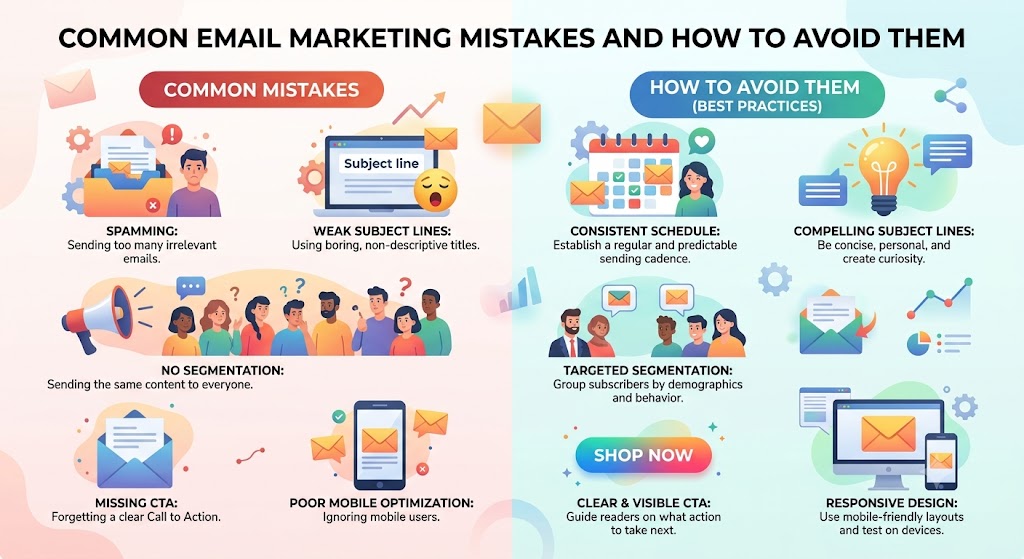
Email marketing remains one of the most effective digital marketing channels available today. It provides businesses with a direct way to communicate with customers, build trust, promote products, and increase conversions. However, despite its effectiveness, many businesses fail to achieve the results they expect because of avoidable mistakes. Even small errors can reduce open rates, lower engagement, increase unsubscribe rates, and damage customer relationships.
Successful email marketing is not simply about sending messages to a subscriber list. It requires planning, personalization, consistency, and a deep understanding of customer expectations. Businesses that recognize common email marketing mistakes and take steps to avoid them are more likely to build stronger customer relationships and achieve better long-term results.
⚠️ Why Email Marketing Mistakes Matter
Subscribers receive dozens of emails every day. If your emails appear irrelevant, repetitive, confusing, or overly promotional, people may ignore them, unsubscribe, or mark them as spam. Every mistake creates a missed opportunity to engage and build trust.
1. Sending Emails Without Audience Segmentation
One of the most common email marketing mistakes is treating every subscriber the same. Businesses often send identical messages to their entire email list without considering customer interests, behavior, demographics, or purchase history.
Different subscribers have different needs. A first-time visitor may require educational content, while a loyal customer may be interested in exclusive offers or product updates.
- Segment subscribers based on interests and behavior.
- Create separate campaigns for different customer groups.
- Use customer data to personalize communication.
- Deliver relevant content to each audience segment.
2. Using Weak Subject Lines
The subject line is often the first thing subscribers see. Even the best email content will fail if recipients never open the message. Generic, boring, or misleading subject lines often result in poor open rates.
Customers are more likely to open emails that clearly communicate value and create genuine interest without appearing deceptive.
- Keep subject lines concise and clear.
- Focus on value and relevance.
- Avoid excessive capitalization and spam-like language.
- Test multiple subject line variations.
3. Sending Too Many Emails
Many businesses assume that more emails automatically lead to more sales. In reality, excessive email frequency often leads to subscriber fatigue. Customers who feel overwhelmed by constant messages may stop opening emails or unsubscribe entirely.
Finding the right balance between staying visible and becoming annoying is essential for long-term success.
- Create a consistent email schedule.
- Monitor unsubscribe rates and engagement metrics.
- Allow subscribers to choose email frequency preferences.
- Focus on quality rather than quantity.
4. Ignoring Mobile Users
A large percentage of emails are opened on smartphones and tablets. If emails are difficult to read or interact with on mobile devices, engagement can decline significantly.
Poor mobile experiences create frustration and reduce the likelihood that subscribers will interact with future emails.
- Use responsive email templates.
- Keep text easy to read on smaller screens.
- Use mobile-friendly buttons and layouts.
- Test emails on multiple devices before sending.
5. Focusing Only on Sales
Many businesses make the mistake of turning every email into a sales pitch. While promotional emails are important, customers also want educational content, helpful resources, industry insights, and useful information.
Subscribers are more likely to stay engaged when emails consistently provide value beyond direct promotions.
- Mix promotional and educational content.
- Share useful tips and industry updates.
- Provide value before asking for a purchase.
- Build trust through helpful communication.
6. Neglecting Personalization
Generic emails often feel impersonal and irrelevant. Modern customers expect personalized experiences that reflect their interests and previous interactions.
Even basic personalization can significantly improve engagement and create stronger customer relationships.
- Use subscriber names when appropriate.
- Recommend products based on previous purchases.
- Create behavior-based email workflows.
- Segment audiences for more relevant messaging.
7. Failing to Monitor Analytics
Many businesses send campaigns without reviewing performance data. Without analytics, it becomes difficult to understand what works and what needs improvement.
Metrics such as open rates, click-through rates, conversions, bounce rates, and unsubscribe rates provide valuable insights into campaign effectiveness.
- Review campaign reports regularly.
- Track engagement metrics over time.
- Identify high-performing content.
- Use data to improve future campaigns.
8. Purchasing Email Lists
Some businesses attempt to grow quickly by purchasing email lists. While this may seem like a shortcut, it often creates significant problems. Purchased contacts may have no interest in the business and are more likely to ignore messages or mark them as spam.
Building an audience organically typically produces better engagement and stronger customer relationships.
- Grow your list through legitimate signup forms.
- Offer valuable incentives for subscriptions.
- Focus on quality rather than list size.
- Maintain permission-based marketing practices.
9. Not Testing Emails Before Sending
Broken links, formatting issues, incorrect personalization, and display problems can damage credibility. Sending emails without testing increases the risk of mistakes reaching subscribers.
- Preview emails before sending.
- Test links and buttons.
- Check formatting across devices.
- Review personalization fields carefully.
💡 Quick Success Tips
- Keep emails clear and easy to read.
- Focus on subscriber value.
- Use strong but honest subject lines.
- Segment audiences whenever possible.
- Continuously test and improve campaigns.
- Monitor performance metrics regularly.
- Build trust through consistent communication.
Final Thoughts
Email marketing remains one of the highest-performing digital marketing channels, but success requires more than simply sending messages. Businesses that avoid common mistakes such as poor segmentation, excessive email frequency, weak subject lines, lack of personalization, and inadequate testing are more likely to achieve strong engagement and lasting customer relationships.
By focusing on relevance, value, personalization, and continuous improvement, businesses can transform email marketing into a powerful tool for customer communication and long-term growth. Small adjustments often produce significant results, making email marketing one of the most cost-effective strategies available to modern organizations.