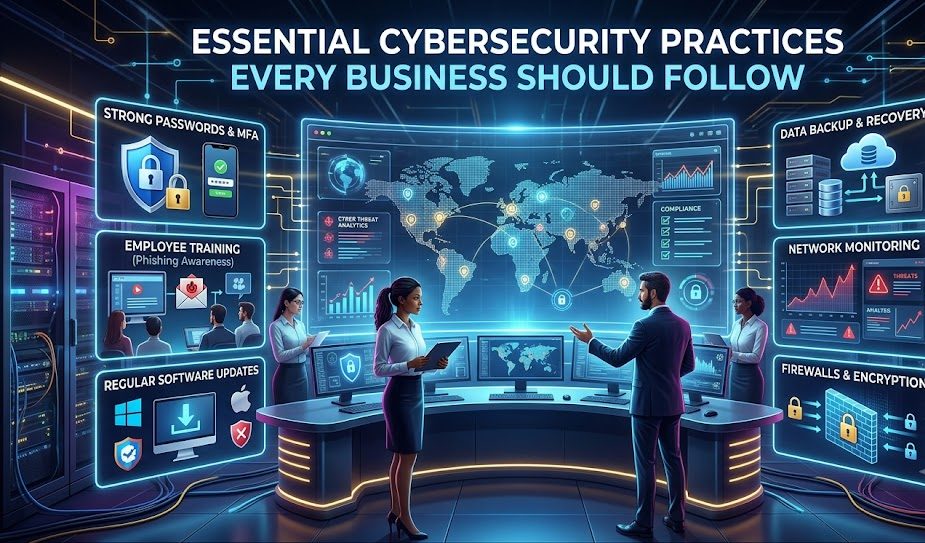
Cybersecurity is no longer just an IT concern—it has become a critical business responsibility. Organizations of all sizes rely heavily on digital systems, cloud services, online communication, and connected devices to operate efficiently. While technology creates opportunities for growth and innovation, it also exposes businesses to a growing number of cyber threats. From phishing scams and ransomware attacks to data breaches and insider threats, cybercriminals constantly search for vulnerabilities they can exploit.
Many businesses assume they are too small to become targets, but cybercriminals often focus on organizations with weaker security measures. A single successful attack can lead to financial losses, operational disruptions, legal issues, and long-term reputational damage. Implementing essential cybersecurity practices helps reduce these risks and creates a stronger foundation for protecting sensitive information, employees, customers, and business operations.
🛡️ Cybersecurity Is a Business Priority
Cybersecurity is not only about preventing attacks. It is also about maintaining customer trust, protecting valuable data, ensuring operational continuity, and supporting sustainable business growth.
Understand the Risks Your Business Faces
Before implementing security controls, businesses should understand the threats they are most likely to encounter. Different industries face different risks depending on the type of data they handle and the technologies they use.
Common cyber threats include:
- Phishing attacks targeting employees.
- Ransomware infections.
- Malware and spyware attacks.
- Unauthorized network access.
- Data theft and information leaks.
- Password compromise incidents.
- Cloud security vulnerabilities.
- Insider threats from employees or contractors.
Understanding these risks allows businesses to prioritize security investments more effectively.
Use Strong Password Policies
Weak passwords remain one of the most common causes of security breaches. Cybercriminals frequently use automated tools to guess passwords or exploit credentials exposed through previous data breaches.
Businesses should establish clear password policies that encourage stronger authentication practices across the organization.
🔐 Strong Password Guidelines
- Use long and complex passwords.
- Avoid reusing passwords across accounts.
- Update passwords when necessary.
- Use password management tools.
- Prevent password sharing among employees.
Strong passwords create an important first line of defense against unauthorized access.
Enable Multi-Factor Authentication
Even strong passwords can sometimes be compromised. Multi-factor authentication adds an additional layer of security by requiring users to verify their identity through a second authentication method.
This additional verification step significantly reduces the likelihood that stolen credentials alone can be used to access business systems.
| Authentication Factor | Example |
|---|---|
| Something You Know | Password or PIN |
| Something You Have | Mobile verification code |
| Something You Are | Fingerprint or facial recognition |
Keep Software and Systems Updated
Software updates often include security patches that address newly discovered vulnerabilities. Delaying updates gives attackers more time to exploit known weaknesses.
Businesses should create a process for regularly updating operating systems, applications, browsers, cloud services, and security tools.
Train Employees on Cybersecurity Awareness
Employees often represent both the strongest defense and the weakest security link within an organization. Many successful cyberattacks begin with human error rather than technical vulnerabilities.
Regular cybersecurity awareness training helps employees recognize common threats and respond appropriately when suspicious situations arise.
- Identify phishing emails.
- Recognize suspicious websites.
- Handle sensitive information securely.
- Report unusual activity promptly.
- Follow company security policies.
Well-trained employees significantly reduce the likelihood of successful attacks.
Implement Reliable Data Backup Procedures
Data loss can occur because of cyberattacks, hardware failures, accidental deletion, or natural disasters. Regular backups help businesses recover quickly and minimize operational disruptions.
A comprehensive backup strategy should include:
- Frequent backup schedules.
- Secure backup storage.
- Offsite or cloud-based backups.
- Backup testing and verification.
- Documented recovery procedures.
Reliable backups are particularly important for defending against ransomware attacks.
Protect Business Networks
Business networks serve as the foundation for communication, collaboration, and data access. Securing these networks is essential for preventing unauthorized access and limiting the spread of cyber threats.
Network security measures may include:
- Firewalls.
- Intrusion detection systems.
- Secure Wi-Fi configurations.
- Network segmentation.
- Access control policies.
🚨 Network Security Matters
A compromised network can expose multiple devices and systems simultaneously, increasing the impact of a security incident.
Control Access to Sensitive Information
Not every employee requires access to all business data. Limiting access based on job responsibilities helps reduce security risks and minimizes potential damage if an account becomes compromised.
Businesses should follow the principle of least privilege, providing employees with only the access necessary to perform their duties.
- Review permissions regularly.
- Remove unnecessary access rights.
- Monitor privileged accounts.
- Secure administrative credentials.
Monitor Systems and Security Events
Continuous monitoring helps businesses identify unusual activity before it develops into a major incident. Security monitoring tools can detect unauthorized access attempts, malware activity, suspicious network traffic, and policy violations.
Early detection allows organizations to respond quickly and minimize potential damage.
Businesses should regularly review logs, alerts, and system reports to identify emerging risks.
Develop an Incident Response Plan
Even organizations with strong defenses may eventually experience a security incident. Having a documented response plan helps reduce confusion and improves recovery efforts.
An incident response plan should define:
- Roles and responsibilities.
- Communication procedures.
- Containment strategies.
- Recovery processes.
- Post-incident reviews.
Preparation helps businesses respond more effectively during stressful situations.
📋 Essential Cybersecurity Checklist
- Use strong passwords and authentication controls.
- Enable multi-factor authentication.
- Update software regularly.
- Train employees on security awareness.
- Back up critical data frequently.
- Protect networks with firewalls and monitoring tools.
- Limit access to sensitive information.
- Monitor systems for unusual activity.
- Create an incident response plan.
- Review cybersecurity practices regularly.
Final Thoughts
Cybersecurity is an ongoing process that requires attention, planning, and continuous improvement. As cyber threats become more sophisticated, businesses must adopt proactive security practices to protect their operations, employees, customers, and sensitive information.
By implementing strong authentication measures, maintaining software updates, educating employees, securing networks, backing up data, and monitoring systems effectively, organizations can significantly reduce their exposure to cyber risks.
Businesses that treat cybersecurity as a strategic priority are better prepared to navigate today’s digital environment, maintain customer trust, and support long-term success in an increasingly connected world.