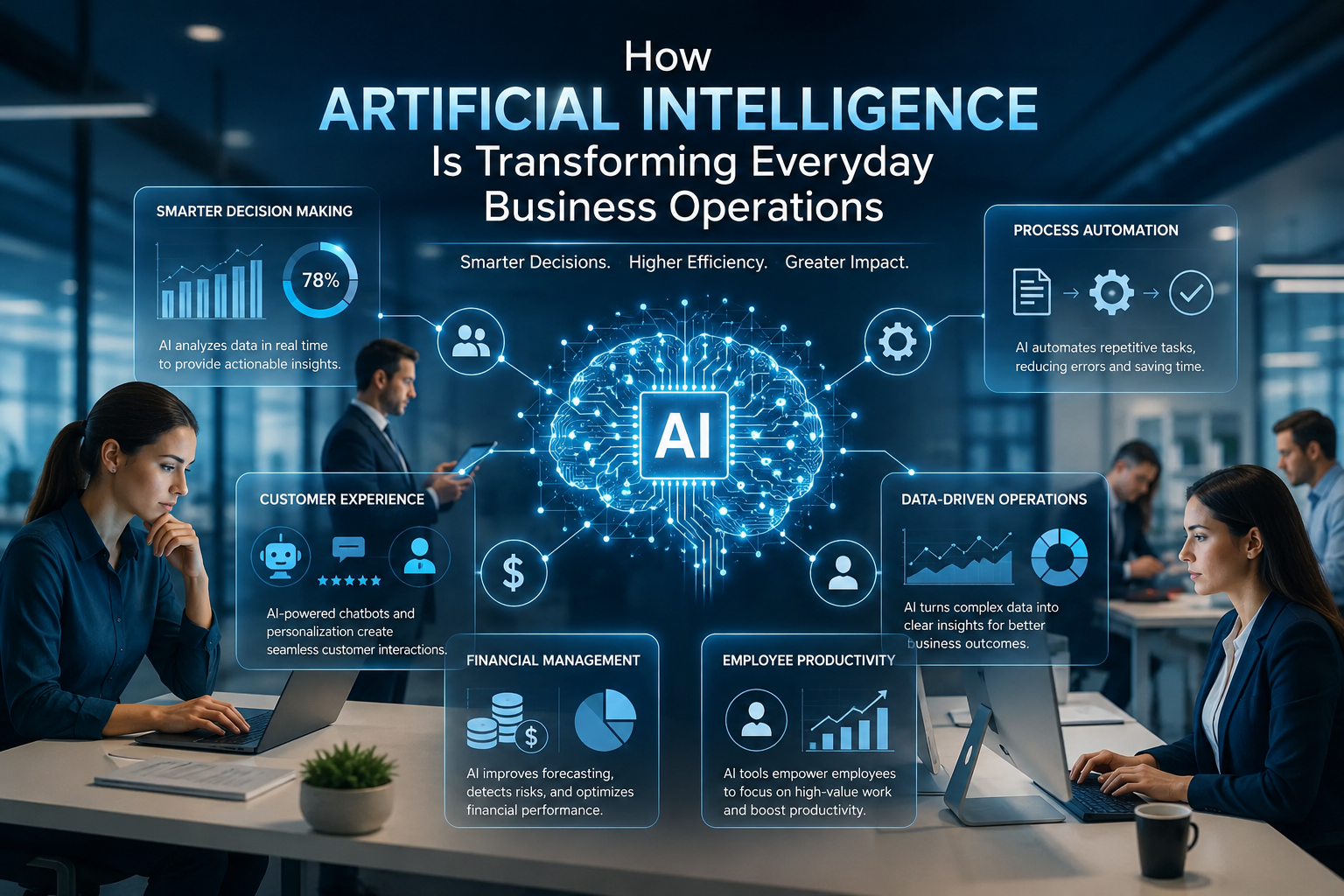
Artificial intelligence is no longer a futuristic concept reserved for large technology companies. In 2026, AI has become an everyday business tool used by organizations of all sizes to improve efficiency, automate repetitive work, enhance customer experiences, and support smarter decision-making. From small startups and online stores to established enterprises, businesses across industries are integrating AI into their daily operations to remain competitive in an increasingly digital marketplace.
Just a few years ago, many routine business activities required significant manual effort. Employees spent hours entering data, responding to repetitive customer questions, organizing information, creating reports, scheduling meetings, and managing administrative tasks. Today, artificial intelligence is helping businesses automate many of these responsibilities, allowing teams to focus on strategy, innovation, and growth rather than repetitive operational work.
◆ The Rise of Practical AI
The biggest change in recent years is that AI has moved from experimental technology to practical business software. Organizations no longer need large development teams or specialized technical expertise to benefit from artificial intelligence. Many modern business tools now include built-in AI capabilities that improve productivity automatically.
Making Business Processes Faster and More Efficient
One of the most significant impacts of artificial intelligence is its ability to reduce the time required to complete routine tasks. Businesses generate large amounts of information every day, including emails, invoices, customer inquiries, reports, contracts, and operational records. Processing all this information manually can be both expensive and time-consuming.
AI-powered systems help organize, categorize, analyze, and process information automatically. Tasks that previously required hours of employee effort can often be completed in minutes. This efficiency allows businesses to operate more effectively while reducing operational costs.
| Business Function | How AI Helps |
|---|---|
| Data Entry | Automates information processing |
| Reporting | Generates summaries automatically |
| Scheduling | Coordinates meetings efficiently |
| Customer Service | Provides faster responses |
Improving Customer Service Experiences
Customer expectations continue to increase. People expect fast responses, accurate information, and convenient support options. Artificial intelligence is helping businesses meet these expectations through chatbots, virtual assistants, automated help centers, and intelligent customer support systems.
AI-powered customer service tools can answer frequently asked questions, provide product information, guide users through processes, and escalate complex issues to human representatives when necessary. This improves response times while allowing support teams to focus on more challenging customer needs.
◈ Customer Service Benefits
- Faster response times.
- 24/7 customer support availability.
- Reduced support workloads.
- Improved customer satisfaction.
- More consistent service quality.
Enhancing Marketing Performance
Marketing teams use artificial intelligence to improve campaign performance, create content, analyze customer behavior, and identify growth opportunities. AI tools can evaluate large amounts of customer data and uncover patterns that might be difficult for humans to recognize manually.
Businesses can use AI to personalize email campaigns, recommend products, optimize advertising strategies, and generate content ideas more efficiently.
Instead of relying solely on assumptions, marketers can make decisions based on real-time data and predictive insights generated by AI systems.
- Email campaign optimization.
- Customer segmentation.
- Content generation support.
- Advertising analysis.
- Lead qualification.
- Audience targeting.
Supporting Better Business Decisions
Every business generates valuable data, but having data alone is not enough. Decision-makers must be able to understand and use information effectively. Artificial intelligence helps organizations analyze large datasets and identify meaningful insights more quickly.
AI systems can evaluate trends, forecast demand, identify risks, monitor performance metrics, and highlight opportunities that support informed decision-making.
This enables leaders to make faster, more confident decisions based on evidence rather than intuition alone.
◈ Decision-Making Advantages
- Faster analysis.
- Improved forecasting.
- Better risk identification.
- Enhanced operational visibility.
- Data-driven planning.
Automating Administrative Tasks
Administrative work consumes a significant portion of employee time. Scheduling meetings, processing documents, managing records, organizing files, and responding to routine communications often distract teams from higher-value responsibilities.
AI automation tools help streamline these tasks through intelligent workflows, automated document processing, scheduling assistants, and communication support systems.
As a result, businesses can improve productivity without increasing headcount.
Transforming Financial Operations
Finance departments are increasingly using AI to improve bookkeeping, reporting, budgeting, forecasting, and transaction management. AI systems can identify unusual transactions, categorize expenses, reconcile accounts, and generate financial insights automatically.
This helps businesses improve financial accuracy while reducing the administrative burden associated with financial management.
| Financial Activity | AI Contribution |
|---|---|
| Expense Tracking | Automatic categorization |
| Reporting | Real-time financial insights |
| Forecasting | Predictive analysis |
| Reconciliation | Automated matching |
Strengthening Cybersecurity Efforts
Cybersecurity threats continue to evolve, making proactive protection increasingly important. Artificial intelligence helps businesses identify unusual activity, detect potential threats, and respond more quickly to security incidents.
AI-powered security systems can analyze network behavior, monitor user activity, identify suspicious patterns, and support faster threat detection than traditional manual approaches.
While AI does not eliminate cybersecurity risks completely, it strengthens organizational defenses and improves response capabilities.
- Threat detection.
- Fraud monitoring.
- Behavior analysis.
- Access monitoring.
- Security alert prioritization.
Supporting Human Employees Rather Than Replacing Them
One of the most common misconceptions about artificial intelligence is that it exists primarily to replace human workers. In reality, most business applications of AI focus on augmenting employee capabilities rather than eliminating jobs entirely.
AI handles repetitive, data-intensive, and administrative tasks, allowing employees to concentrate on activities that require creativity, judgment, relationship-building, and strategic thinking.
Organizations that combine human expertise with AI support often achieve better results than either approach alone.
Preparing for the Future of Business Operations
Artificial intelligence will continue evolving and becoming more deeply integrated into everyday business software. Future advancements are expected to provide even greater automation, predictive capabilities, personalization, and operational efficiency.
Businesses that begin adopting AI thoughtfully today may be better positioned to adapt to future technological developments and maintain competitive advantages in their industries.
◆ Practical AI Adoption Framework
- Identify repetitive business processes.
- Start with simple automation projects.
- Train employees on AI-assisted workflows.
- Monitor performance improvements.
- Maintain human oversight for important decisions.
- Expand AI usage gradually.
- Review security and privacy requirements.
- Focus on measurable business outcomes.
Final Thoughts
Artificial intelligence is transforming everyday business operations by helping organizations automate routine work, improve customer experiences, enhance decision-making, strengthen security, and increase overall productivity. What was once considered advanced technology has now become a practical business tool accessible to organizations of every size.
From customer service and marketing to finance, cybersecurity, and administration, AI is creating opportunities for businesses to operate more efficiently while allowing employees to focus on higher-value activities. The most successful organizations are not replacing human expertise with AI but combining both to achieve better results.
As artificial intelligence continues to evolve, businesses that embrace thoughtful adoption strategies will be better positioned to improve efficiency, support innovation, and build sustainable growth in an increasingly competitive digital economy.