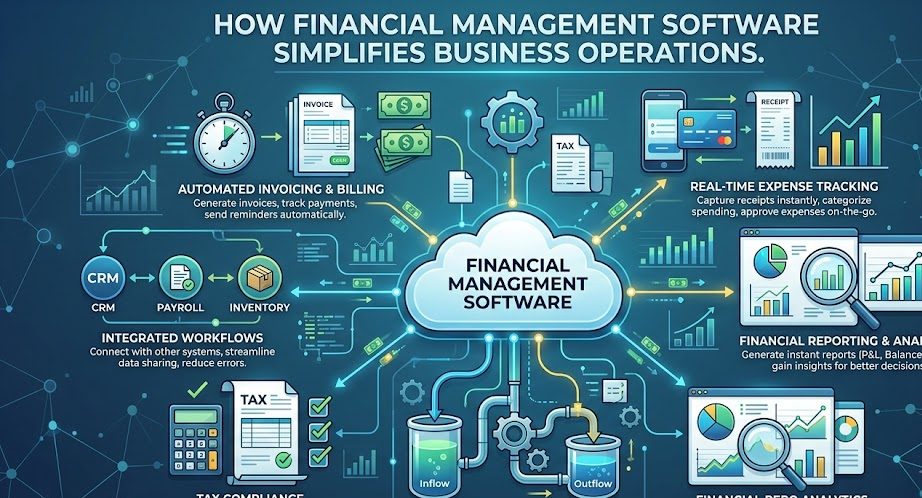
Managing finances is one of the most important responsibilities for any business. Whether a company is a startup, a growing small business, or an established organization, financial management directly influences profitability, sustainability, and future growth. As businesses handle larger volumes of transactions, invoices, payroll, expenses, and financial reporting, manual processes often become inefficient and difficult to maintain. Financial management software helps solve these challenges by automating routine tasks, improving accuracy, and providing better visibility into business performance.
Modern financial management software has evolved far beyond traditional bookkeeping tools. Today’s platforms help businesses track cash flow, manage budgets, automate reporting, process invoices, monitor expenses, and make informed decisions based on real-time financial data. By reducing administrative workload and improving financial control, these solutions allow organizations to focus more on growth and strategic planning.
💼 Why Financial Management Matters
Strong financial management helps businesses maintain healthy cash flow, control spending, improve profitability, prepare for tax obligations, and make confident decisions. Without proper financial oversight, even profitable businesses can experience operational challenges.
Understanding Financial Management Software
Financial management software is designed to help businesses organize, monitor, and control financial activities from a centralized platform. Instead of relying on spreadsheets, paper records, or disconnected systems, organizations can manage multiple financial processes within a single environment.
These platforms often combine accounting, budgeting, forecasting, reporting, invoicing, payroll management, and expense tracking capabilities. The result is greater efficiency, better data accuracy, and improved financial visibility.
Automating Routine Financial Tasks
One of the biggest advantages of financial management software is automation. Many financial activities require repetitive data entry and manual calculations that consume valuable time and increase the risk of errors.
Automation allows businesses to streamline processes such as:
- Invoice generation.
- Expense categorization.
- Bank reconciliation.
- Payment reminders.
- Payroll calculations.
- Recurring transactions.
- Financial reporting.
By reducing manual intervention, businesses can improve efficiency while minimizing costly mistakes.
⚡ Automation Benefits
- Reduces administrative workload.
- Improves accuracy.
- Speeds up financial processes.
- Minimizes human errors.
- Allows employees to focus on higher-value tasks.
Improving Cash Flow Management
Cash flow is often described as the lifeblood of a business. Even profitable companies can experience difficulties if cash inflows and outflows are not managed effectively.
Financial management software provides real-time visibility into cash positions, helping businesses understand available funds, upcoming expenses, and outstanding receivables.
| Cash Flow Function | Business Benefit |
|---|---|
| Income Tracking | Improves revenue visibility |
| Expense Monitoring | Controls spending |
| Payment Tracking | Reduces overdue invoices |
| Forecasting | Supports planning decisions |
Better cash flow visibility allows organizations to plan more effectively and avoid financial surprises.
Simplifying Financial Reporting
Financial reports play a crucial role in understanding business performance. However, creating reports manually can be time-consuming and prone to errors.
Financial management software automatically generates reports that provide insights into profitability, expenses, revenue trends, cash flow, and overall financial health.
Common reports include:
- Profit and loss statements.
- Balance sheets.
- Cash flow reports.
- Expense summaries.
- Revenue reports.
- Budget performance reports.
Managing Expenses More Effectively
Expense management becomes increasingly challenging as businesses grow. Employees may submit receipts from multiple locations, departments may incur different types of expenses, and approval workflows may become more complicated.
Financial management software simplifies expense tracking by providing centralized visibility into spending activities. Many platforms allow employees to upload receipts digitally, categorize expenses automatically, and submit reimbursement requests through streamlined workflows.
This improves accountability while helping organizations identify unnecessary spending.
Enhancing Budget Planning
Budgeting is essential for maintaining financial discipline and supporting long-term growth. Financial management software helps businesses create, monitor, and adjust budgets more effectively.
Managers can compare actual spending against budgeted amounts, identify variances, and make informed adjustments when necessary.
Improved budgeting helps businesses:
- Control costs.
- Allocate resources efficiently.
- Support growth initiatives.
- Reduce financial uncertainty.
- Improve profitability.
Supporting Compliance and Tax Preparation
Regulatory requirements and tax obligations can create significant administrative burdens. Financial management software helps maintain organized financial records, making compliance and tax preparation more manageable.
Automated recordkeeping improves documentation quality while reducing the likelihood of missing important financial information.
📋 Compliance Benefits
- Organized financial records.
- Improved audit readiness.
- More accurate tax reporting.
- Reduced administrative effort.
- Better document retention.
Improving Business Decision-Making
Business decisions are most effective when supported by accurate financial data. Financial management software provides executives and managers with real-time insights into performance, helping them make more informed choices.
Instead of relying on outdated reports or incomplete information, leaders can access current financial data whenever needed.
This supports decisions related to:
- Hiring.
- Investments.
- Pricing strategies.
- Expansion plans.
- Cost reduction initiatives.
- Resource allocation.
Cloud Accessibility and Collaboration
Many modern financial management platforms operate in the cloud, allowing users to access financial information from virtually anywhere. This flexibility is especially valuable for remote teams, business owners, accountants, and financial advisors.
Cloud-based systems support collaboration by providing secure access to authorized users while maintaining centralized data management.
Real-time synchronization ensures that everyone works with current information rather than outdated versions of financial records.
Common Challenges Financial Software Helps Solve
- Manual bookkeeping errors.
- Delayed financial reporting.
- Cash flow visibility issues.
- Invoice management difficulties.
- Budget tracking challenges.
- Tax preparation complexity.
- Expense management inefficiencies.
- Disconnected financial systems.
By addressing these challenges, businesses can improve operational efficiency and reduce financial risk.
📊 Financial Management Best Practices
- Automate repetitive financial tasks.
- Monitor cash flow regularly.
- Review financial reports consistently.
- Track expenses accurately.
- Maintain organized financial records.
- Use budgeting tools effectively.
- Protect financial data securely.
- Plan for future growth using financial insights.
Final Thoughts
Financial management software has become an essential tool for businesses seeking greater efficiency, accuracy, and control over their financial operations. By automating routine tasks, improving visibility, simplifying reporting, and supporting better decision-making, these platforms help organizations operate more effectively in an increasingly competitive environment.
Whether managing invoices, tracking expenses, planning budgets, or preparing financial reports, businesses can benefit significantly from modern financial management solutions. The right software not only reduces administrative burdens but also provides valuable insights that support long-term success.
Organizations that embrace financial management technology are often better equipped to manage growth, respond to challenges, and maintain strong financial health in today’s rapidly evolving business landscape.