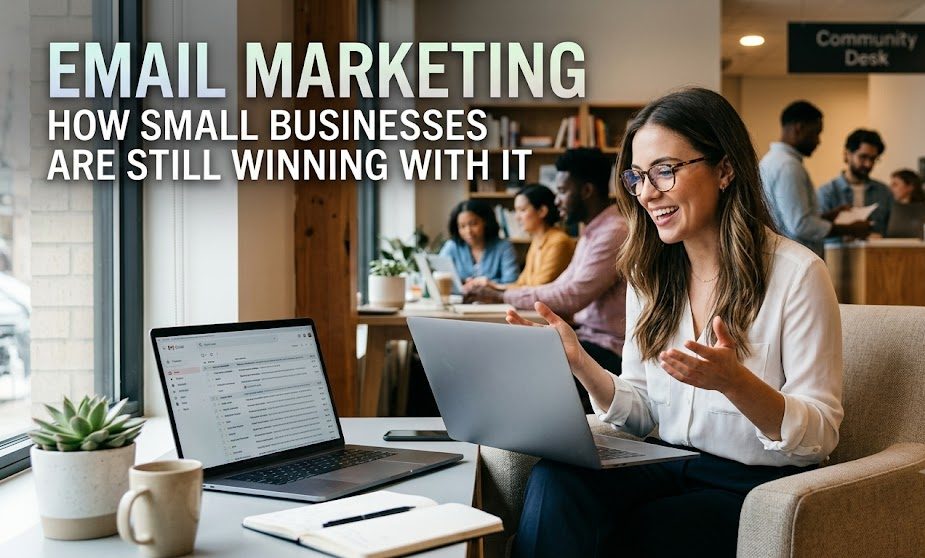
Social platforms can change overnight, but a well-managed email list gives a small business something far more valuable: a direct relationship with people who have already shown interest.
Email marketing may sound like an old-school digital strategy, especially when businesses are surrounded by short videos, social media creators, paid advertising, and AI-powered marketing tools. Yet email continues to have a practical advantage that many newer channels cannot completely replace: the business can communicate directly with people who have chosen to hear from it.
For a small business, that matters. You do not need millions of followers to make email useful. A list of genuinely interested customers can be more valuable than a much larger audience that rarely interacts with your brand.
The businesses getting the most from email today are also not simply sending promotional messages every few days. They are treating email as part of the customer experience. They use it to welcome new subscribers, answer common questions, explain products, share useful information, bring previous customers back, and occasionally make an offer.
Why Email Still Matters for Small Businesses
One of the biggest advantages of email is that the audience relationship is more direct than it is on many social platforms. A social network controls how content is distributed, while an email subscriber has deliberately provided an address and agreed to receive communication.
That does not mean every subscriber will open every message. People ignore emails, unsubscribe, change addresses, and become inactive. But a healthy list gives a business a communication channel it can build over time instead of depending entirely on an algorithmic feed.
Email is particularly powerful after someone has already interacted with a business. A person who downloads a guide, joins a newsletter, requests information, creates an account, or purchases a product has already demonstrated some level of interest.
That creates an opportunity to continue the relationship instead of starting from zero every time the business wants to attract attention.
1. Small Businesses Are Focusing on Better Lists, Not Bigger Lists
A common beginner mistake is treating subscriber count as the main success metric. A list with 50,000 people may look impressive, but if most subscribers never engage, its actual value can be disappointing.
A smaller list containing people who genuinely want the company’s information can be much healthier.
This is why modern email marketing begins with permission and relevance. Businesses should clearly explain what subscribers are signing up for and then deliver content that matches that expectation.
- Tell people what they will receive.
- Do not hide the subscription purpose.
- Use clear signup forms.
- Avoid buying random email lists.
- Give subscribers a simple way to unsubscribe.
The goal is not to collect every possible address. The goal is to build an audience that actually wants to remain connected.
2. Welcome Emails Do More Work Than Many Businesses Realize
The first few emails after someone subscribes can establish the entire relationship.
Instead of immediately sending a sales pitch, a business can use a welcome sequence to explain who it is, what subscribers can expect, and where to find the most useful resources.
For example, a small home-improvement company might send a welcome email introducing its services, followed by a practical maintenance checklist and then a short explanation of the most common problems customers ask about.
A clothing business could introduce its brand story, explain how its products are selected, and then provide styling ideas before presenting a promotional offer.
The important principle is that the customer should understand why remaining subscribed is worthwhile.
Introduce the business and set expectations.
Provide something genuinely useful.
Make a relevant offer when appropriate.
3. Useful Content Beats Constant Promotion
If every email says “Buy now,” subscribers quickly learn to ignore the sender.
Small businesses can avoid this by mixing promotional messages with useful content. The exact balance depends on the business, but the underlying idea is simple: earn attention before asking for money.
A local bakery could share seasonal recipes, behind-the-scenes stories, new product announcements, and occasional discounts. A software company could publish practical tutorials, product tips, case studies, and feature updates. A consultant could answer common customer questions and explain mistakes that businesses frequently make.
This makes email feel less like advertising and more like a useful resource.
4. Segmentation Makes Ordinary Emails More Relevant
Not every customer has the same needs.
A new subscriber should not necessarily receive the same message as someone who has purchased five times. Someone interested in one product category may not care about another.
Segmentation allows a business to divide its audience based on meaningful information such as previous purchases, interests, signup source, location, or engagement.
Even simple segmentation can make a noticeable difference.
| Audience | Possible Email |
|---|---|
| New subscribers | Welcome and introductory content |
| Recent buyers | Product guidance or follow-up |
| Repeat customers | Loyalty offers or new products |
| Inactive subscribers | Re-engagement message |
5. Personalization Is More Than Adding a First Name
Putting someone’s first name in a subject line can be useful, but it is not the most meaningful form of personalization.
Real personalization comes from understanding what the subscriber is likely to care about.
If someone purchased running shoes, an email about shoe maintenance or running accessories is naturally more relevant than a completely unrelated promotion. If a customer repeatedly reads content about gardening, sending practical gardening information makes more sense than randomly promoting another category.
AI is also making personalization easier for smaller teams. Businesses can use AI to help analyze customer behavior, suggest content variations, summarize feedback, and create different versions of messages. The final communication should still be reviewed by a human, particularly when customer data or sensitive information is involved.
6. Automation Lets a Small Team Behave Like a Larger One
This is where email becomes especially powerful.
A small business owner does not want to manually send every welcome email, abandoned-cart reminder, follow-up message, or birthday promotion.
Automation can handle predictable moments in the customer journey.
- Welcome emails after signup.
- Follow-ups after purchases.
- Educational sequences for new leads.
- Abandoned-cart reminders for online stores.
- Re-engagement campaigns for inactive subscribers.
- Review requests after an appropriate customer interaction.
Once these sequences are properly configured, they can operate continuously while the business concentrates on higher-value work.
A Simple Automation Example
Day 0: Welcome email
Day 2: Helpful guide or educational content
Day 5: Popular product, service, or resource
Day 9: Customer story or case study
Day 14: Relevant offer or next step
7. The Subject Line Still Matters
An excellent email is useless if nobody opens it.
That makes the subject line important, but businesses should resist the temptation to use exaggerated clickbait. A subject should communicate enough information to make the reader curious while remaining honest about what is inside.
Clear subject lines often work better as long-term business communication because subscribers learn what to expect from the sender.
For example, instead of a vague subject such as “You won’t believe this,” a gardening business might write “Three ways to improve container soil this month.” The second subject gives the reader a clear reason to open the email.
8. Mobile-Friendly Design Is No Longer Optional
Many people read email from their phones, which means a beautiful desktop newsletter can still fail if it is difficult to read on a small screen.
Small businesses should prioritize clean layouts, readable typography, obvious buttons, short sections, and fast-loading images.
A good email does not need to look like a complicated magazine. In many situations, a simple design with a strong headline, useful information, and one clear action is more effective.
9. Measure the Numbers That Actually Matter
Email platforms can provide dozens of statistics, but not every number deserves equal attention.
Open rates can provide useful directional information, but they should not be treated as a perfect measurement because technical changes can affect tracking. Clicks, conversions, revenue, unsubscribes, and engagement over time can provide a more useful picture of whether campaigns are accomplishing their business goals.
A small business should ask practical questions:
- Did subscribers click?
- Did they visit the website?
- Did they make a purchase?
- Did they request information?
- Did the campaign generate repeat business?
- Did people unsubscribe because the content was irrelevant?
The purpose of analytics is not to create impressive reports. It is to improve the next campaign.
A Lean Email Strategy for a Small Business
You do not need a marketing department to begin.
Start with a clear signup opportunity on your website. Explain what subscribers will receive. Create a welcome sequence. Send useful content consistently. Add promotional messages when they genuinely fit. Then review the results and improve the process.
The Small-Business Email Formula
Build the list → Welcome subscribers → Teach something useful → Segment the audience → Automate repetitive moments → Make relevant offers → Measure results → Improve.
What Small Businesses Should Avoid
There are several habits that can damage an otherwise promising email strategy.
- Buying email lists from unknown providers.
- Sending messages far more frequently than subscribers expected.
- Using misleading subject lines.
- Making every email a sales pitch.
- Ignoring unsubscribe requests.
- Sending the same message to every customer.
- Failing to check emails on mobile devices.
- Continuing to send campaigns to permanently inactive contacts without a clear reason.
Businesses should also follow the email marketing and privacy requirements that apply to their audience and location. Permission, transparency, appropriate data handling, and clear unsubscribe mechanisms are not merely technical details; they are part of maintaining customer trust.
Final Takeaway
Email marketing is still winning in 2026 because it solves a simple business problem: how do you stay connected with people after they discover you?
The strongest small businesses are not trying to send the most emails. They are trying to send better ones.
They build permission-based lists, welcome new subscribers properly, provide useful information, segment audiences, automate repetitive communication, personalize where it genuinely helps, and measure whether their messages create meaningful business results.
Social media can help a business get discovered. Search can bring new visitors. Advertising can accelerate growth. But email can help turn attention into an ongoing relationship.
That is why email marketing has not disappeared. It has simply matured. In 2026, the winning strategy is less about sending more messages and more about becoming worth opening.