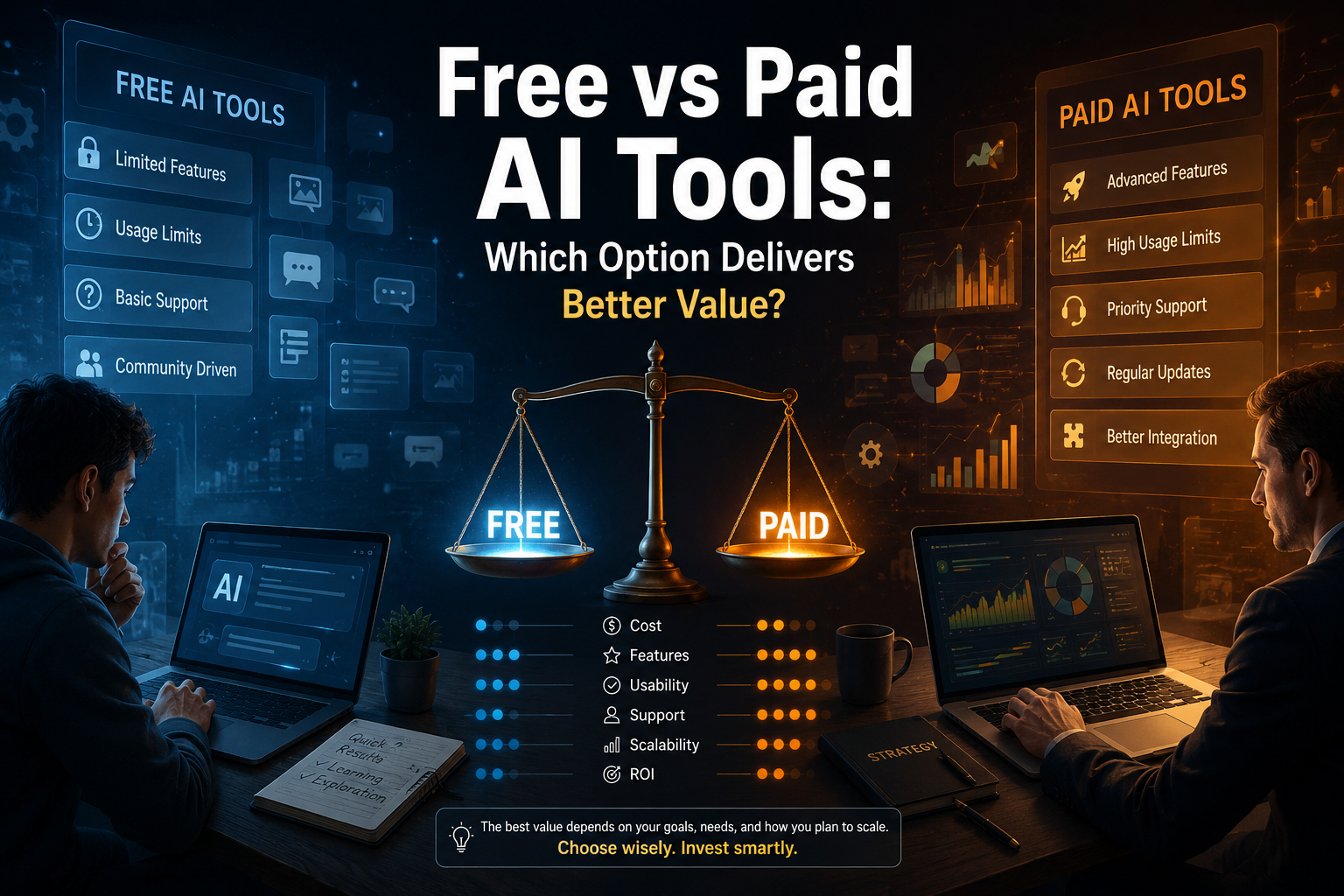
Artificial intelligence has become one of the most accessible business technologies available today. From content creation and customer support to data analysis and workflow automation, AI tools are helping businesses save time, improve efficiency, and reduce operational costs. As AI adoption continues to grow, one question remains common among business owners, freelancers, marketers, and entrepreneurs: should you use free AI tools or invest in paid solutions? While both options can deliver value, the answer depends on how AI fits into your workflow, productivity requirements, and long-term business goals.
Many people start with free AI tools because they offer an easy way to explore artificial intelligence without financial commitment. However, as usage increases and business requirements become more demanding, paid plans often provide additional capabilities that may justify the investment. Understanding the strengths and limitations of both options helps businesses make more informed decisions.
◆ The Real Question Isn’t Free vs Paid
The most important consideration is value. A free tool that saves hours every week may be extremely valuable, while an expensive premium subscription that goes unused may provide very little return. The goal is to match AI capabilities with actual business needs.
Understanding Free AI Tools
Free AI tools are designed to provide basic functionality without requiring payment. They allow users to test AI capabilities, learn how the technology works, and complete many common tasks without financial risk.
For students, freelancers, hobbyists, startups, and small businesses with limited budgets, free AI solutions often provide a practical starting point.
- Basic content generation.
- Simple AI chat assistance.
- Limited image creation.
- Basic productivity features.
- Restricted daily usage limits.
- Standard automation capabilities.
Many businesses begin with free plans and upgrade later when operational demands increase.
Advantages of Free AI Tools
The biggest advantage of free AI software is obvious: there is no direct financial cost. This makes experimentation easier and lowers the barrier to entry for organizations interested in exploring AI technology.
- No subscription fees.
- Easy access for beginners.
- Low-risk experimentation.
- Useful for occasional tasks.
- Good for learning AI workflows.
- Suitable for personal projects.
◈ Best Situations for Free AI Tools
- Testing AI before purchasing.
- Personal productivity tasks.
- Learning AI fundamentals.
- Low-volume content creation.
- Small projects with limited budgets.
Limitations of Free AI Tools
Although free tools can be extremely useful, they often come with restrictions designed to encourage upgrades. These limitations may not matter for casual users, but they can become obstacles for businesses that rely heavily on AI.
| Common Limitation | Potential Impact |
|---|---|
| Usage limits | Reduced productivity |
| Fewer features | Limited functionality |
| Slower performance | Longer task completion times |
| Basic support | Reduced assistance |
| Lower priority access | Service interruptions |
As AI becomes integrated into daily operations, these limitations may affect efficiency and scalability.
What Paid AI Tools Offer
Paid AI tools typically provide expanded functionality, higher usage limits, faster processing, premium models, enhanced security, and more advanced automation capabilities.
Businesses that depend heavily on AI often choose premium plans because reliability and productivity gains outweigh subscription costs.
- Advanced AI models.
- Higher usage allowances.
- Faster response speeds.
- Priority access.
- Enhanced automation tools.
- Business integrations.
- Collaboration features.
- Dedicated support options.
Benefits of Paid AI Solutions
Businesses often invest in paid AI software because the productivity gains can exceed subscription costs. Even modest time savings can generate significant value when applied across teams and workflows.
Premium AI solutions frequently deliver:
- More reliable performance.
- Improved output quality.
- Greater automation capabilities.
- Enhanced security controls.
- Better collaboration features.
- Higher scalability.
- Reduced operational friction.
◈ Business Value Pattern
If a paid AI tool saves an employee just one hour per week, the productivity benefit may quickly exceed the monthly subscription cost. This is one reason many organizations view AI software as an investment rather than an expense.
When Free AI Tools Are Enough
Not every user requires premium functionality. Many individuals and small businesses achieve excellent results using free versions of AI software.
Free tools may be sufficient when:
- Usage is occasional.
- Projects are relatively simple.
- Budget is limited.
- Advanced features are unnecessary.
- AI is used primarily for learning.
- Workloads remain manageable.
In these situations, upgrading may not provide enough additional value to justify the cost.
When Paid AI Tools Make Sense
As businesses grow, AI often becomes integrated into critical workflows. At that stage, premium plans can provide meaningful operational advantages.
Paid AI software may be worth considering when:
- Daily usage is high.
- Teams rely on AI extensively.
- Workflow automation is important.
- Reliability becomes critical.
- Collaboration features are required.
- Security requirements increase.
- Scalability becomes a priority.
◈ Upgrade Indicators
- Frequently hitting usage limits.
- Needing faster performance.
- Requiring advanced automation.
- Managing larger teams.
- Handling higher workloads.
- Seeking better integrations.
Comparing Cost and Value
Businesses should evaluate AI software based on return on investment rather than subscription price alone. A tool that saves significant time, improves efficiency, or increases revenue may deliver substantial value even if it requires a monthly fee.
The most useful evaluation questions include:
- How much time does the tool save?
- Does it improve workflow efficiency?
- Can it automate repetitive tasks?
- Will it support future growth?
- Does it improve output quality?
- Can it reduce operational costs?
These factors often matter more than the monthly subscription price itself.
◆ Smart Evaluation Framework
- Start with free plans when possible.
- Measure productivity improvements.
- Identify workflow bottlenecks.
- Calculate time savings.
- Compare costs against benefits.
- Upgrade only when additional value is clear.
- Review usage regularly.
- Focus on business outcomes rather than features alone.
Finding the Right Balance
Many businesses ultimately use a combination of free and paid AI tools. Some tasks may only require basic functionality, while others benefit from premium features and advanced capabilities.
Rather than viewing the decision as either free or paid, organizations often achieve the best results by matching tool capabilities with actual operational needs.
This balanced approach helps maximize value while controlling software costs.
Final Thoughts
Free AI tools provide an excellent starting point for individuals and businesses exploring artificial intelligence. They offer meaningful functionality without financial risk and can deliver impressive results for many common tasks.
However, paid AI solutions often provide higher usage limits, advanced features, better performance, stronger automation capabilities, and improved reliability. For businesses that rely heavily on AI for productivity, marketing, customer service, or operations, premium plans frequently deliver significant long-term value.
The best choice ultimately depends on how AI supports your workflow. Rather than focusing only on price, evaluate the value the tool creates through time savings, productivity improvements, operational efficiency, and business growth potential.