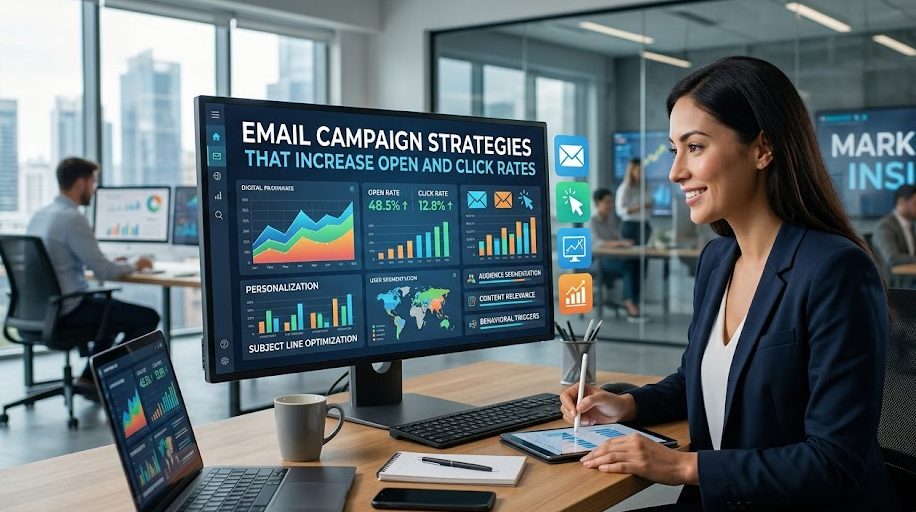
Email marketing continues to be one of the highest-performing digital marketing channels for businesses of all sizes. While social media algorithms change constantly and paid advertising costs continue to increase, email provides a direct communication channel between businesses and their audiences. However, simply sending emails is not enough. The real challenge is getting subscribers to open those emails and take action after reading them.
Many businesses struggle with low open rates and disappointing click-through rates because they focus only on sending campaigns rather than optimizing them. Successful email marketing requires strategy, audience understanding, personalization, and continuous improvement. Businesses that implement effective email campaign strategies often see stronger customer engagement, improved conversions, and higher returns on their marketing investment.
📈 Why Open and Click Rates Matter
Open rates indicate how many subscribers found your email interesting enough to view, while click rates measure how many people interacted with your content. Together, these metrics help businesses understand whether their campaigns are capturing attention and generating engagement.
Create Strong and Relevant Subject Lines
The subject line is often the deciding factor in whether an email gets opened. Even the most valuable content will be ignored if the subject line fails to capture attention. Many marketers spend hours creating email content but only a few minutes writing the subject line, which is a significant mistake.
Effective subject lines should be clear, relevant, and focused on value. Subscribers want to know why they should open the email and what benefit they will receive.
- Keep subject lines concise and easy to understand.
- Create curiosity without being misleading.
- Highlight value or useful information.
- Avoid excessive punctuation and spam-like language.
- Test multiple variations to identify top performers.
Segment Your Audience
One of the biggest reasons email campaigns fail is because businesses send identical messages to every subscriber. Different subscribers have different interests, needs, and behaviors. Sending the same email to everyone often reduces relevance and engagement.
Audience segmentation allows businesses to divide subscribers into smaller groups based on specific criteria. These groups can then receive personalized content that better matches their interests.
🎯 Popular Segmentation Methods
- Purchase history.
- Customer location.
- Industry or profession.
- Engagement level.
- Website activity.
- Product interests.
Segmented campaigns generally produce better engagement because subscribers receive content that feels more relevant to their needs.
Personalize Email Content
Modern consumers expect personalized experiences. Generic emails that look like mass marketing messages often receive lower engagement. Personalization helps businesses create stronger relationships with subscribers by making communication feel more relevant and meaningful.
Personalization extends beyond simply including a subscriber’s first name. Businesses can personalize recommendations, offers, content topics, and messaging based on customer behavior and preferences.
| Personalization Type | Example |
|---|---|
| Name Personalization | Using subscriber names in emails |
| Behavior-Based | Product recommendations |
| Location-Based | Regional promotions |
| Purchase History | Relevant product suggestions |
Optimize Send Times
Timing can significantly influence email performance. Sending an email at the wrong time may result in it getting buried beneath dozens of other messages before subscribers even notice it.
While there is no universal perfect sending time, businesses can improve results by analyzing audience behavior and identifying patterns. Many email marketing platforms provide insights into when subscribers are most active.
Testing different sending times helps determine when your audience is most likely to open and engage with emails.
Focus on Mobile-Friendly Design
A significant portion of email opens occur on smartphones and tablets. If an email is difficult to read or interact with on a mobile device, subscribers may quickly lose interest.
Mobile-friendly emails improve user experience and increase the likelihood of clicks and conversions.
- Use responsive templates.
- Keep paragraphs short.
- Use readable font sizes.
- Create clear call-to-action buttons.
- Optimize images for mobile devices.
Provide Valuable Content
Many businesses focus exclusively on promoting products and services. While promotional campaigns are important, subscribers are more likely to engage when emails provide genuine value.
Educational content, industry insights, practical tips, guides, and useful resources often generate stronger engagement because they help subscribers solve problems or learn something new.
When subscribers consistently receive valuable content, they become more likely to open future emails and trust the sender.
Use Clear Calls to Action
Even highly engaging content may fail to generate clicks if readers do not know what action to take next. Every email should include a clear and compelling call to action that guides subscribers toward a desired outcome.
Calls to action should be easy to find, visually noticeable, and focused on a specific objective.
✅ Effective CTA Examples
- Download the Guide
- Learn More
- Get Started
- View Products
- Claim Your Offer
- Schedule a Consultation
A/B Test Your Campaigns
Successful email marketers rarely rely on assumptions. Instead, they use A/B testing to compare different versions of emails and identify what performs best.
Businesses can test:
- Subject lines.
- Email layouts.
- Call-to-action buttons.
- Images.
- Content length.
- Send times.
Even small improvements discovered through testing can produce significant increases in open and click rates over time.
Maintain List Quality
A large email list is not always an advantage if many subscribers never engage. Inactive contacts can lower engagement rates and reduce campaign effectiveness.
Businesses should regularly review subscriber activity and remove inactive contacts when appropriate. Maintaining a healthy list helps improve deliverability and provides more accurate performance data.
💡 Quick Success Checklist
- Create attention-grabbing subject lines.
- Segment audiences for relevance.
- Personalize content whenever possible.
- Optimize send times.
- Design for mobile devices.
- Provide valuable content.
- Use strong calls to action.
- Test campaigns regularly.
- Maintain a clean subscriber list.
Final Thoughts
Improving email open and click rates requires more than sending frequent campaigns. Businesses must focus on understanding their audience, delivering relevant content, and continuously optimizing their strategy. Every element of an email—from the subject line to the call-to-action—plays a role in determining campaign performance.
The most successful email marketers combine personalization, segmentation, valuable content, and data-driven testing to create campaigns that resonate with subscribers. By implementing these proven strategies, businesses can increase engagement, strengthen customer relationships, and achieve better marketing results over the long term.
Email marketing remains one of the most reliable ways to connect with customers, and businesses that focus on delivering meaningful experiences will continue to see strong returns from their campaigns.